Trio-Spark v1.3: Better decisions on every task we measured
Spark makes one decision inside the bounds your application sets: two to eight choices in, one selected choice and a probability for every choice out, from a single forward pass. No text is generated, so there is no answer to parse.
Trio-Spark v1.3 ships new text weights behind the same API. Request shape, price, limits and image and sampled-video input are unchanged. Use trio-spark-v1.3; existing model names keep working.
Thirteen benchmarks, seven models
We ran v1.3, the two previous releases and four other fast decision models on the same items. Across a ten-task panel of 2,977 decisions, v1.3 answered 90.9% correctly, up from 83.1% for v1.0 and 83.0% for v1.2. It improved on v1.0 on every task where both were measured.
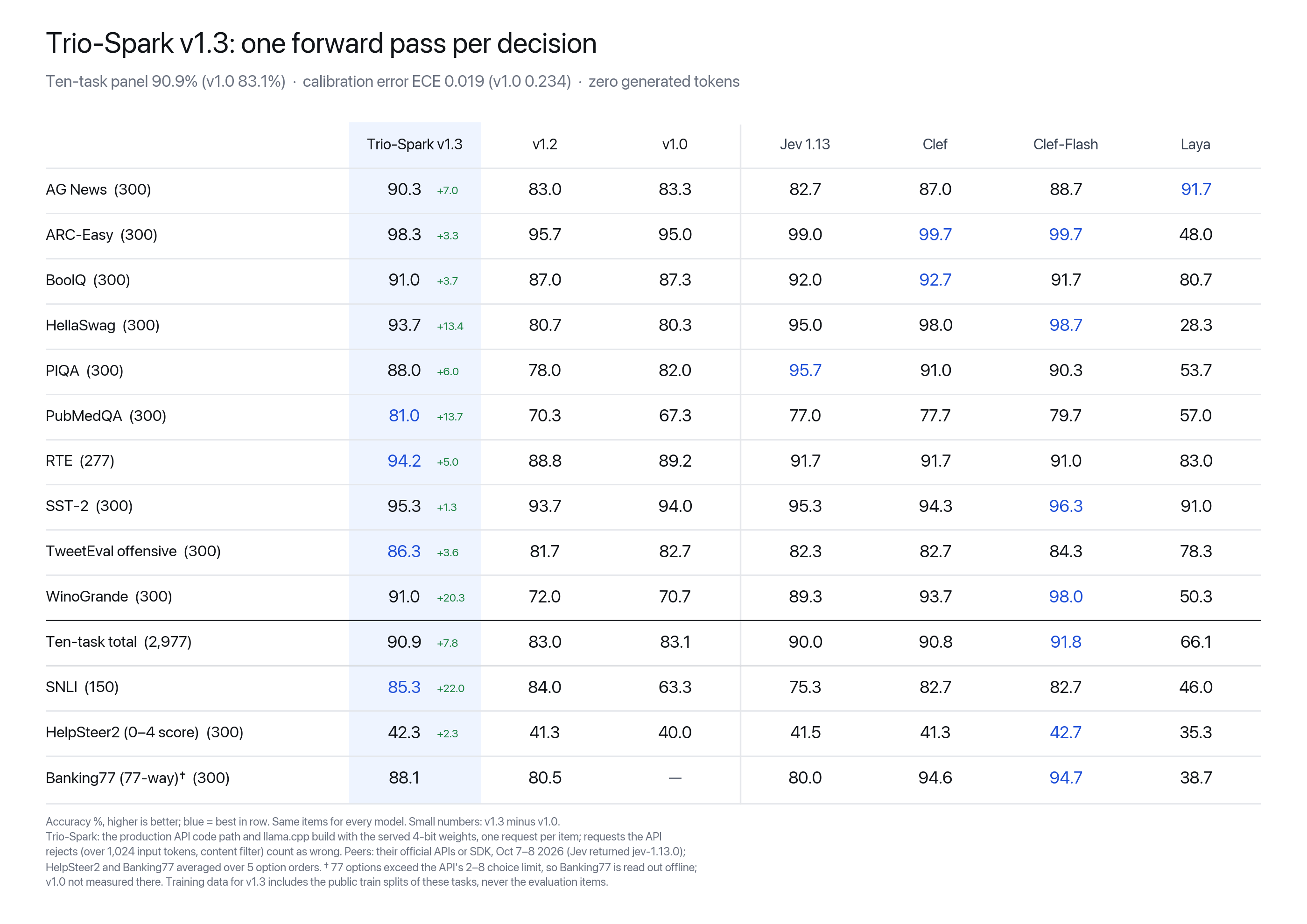
Against other models the picture is mixed, and we want to show it that way. On the panel total v1.3 is level with Clef (90.8%), ahead of Jev 1.13 (90.0%) and behind Clef-Flash (91.8%). It has the best score of the seven on PubMedQA, RTE, TweetEval offensive and SNLI. Elsewhere others lead: Clef-Flash on six rows, including HellaSwag, WinoGrande and Banking77; Jev on PIQA; Clef on BoolQ; Laya on AG News.
Confidence you can threshold
Agents use Spark’s probabilities to decide when to act and when to ask. On the ten-task panel, v1.3’s expected calibration error (10 bins) is 0.019, against 0.058 for v1.2 and 0.234 for v1.0. Its confidence tracks how often it is actually right, so a threshold you set on the probability behaves predictably.
The full table
| Task | Spark v1.3 | Spark v1.2 | Spark v1.0 | Jev 1.13 | Clef | Clef-Flash | Laya |
|---|---|---|---|---|---|---|---|
| AG News (300) | 90.3 | 83.0 | 83.3 | 82.7 | 87.0 | 88.7 | 91.7 |
| ARC-Easy (300) | 98.3 | 95.7 | 95.0 | 99.0 | 99.7 | 99.7 | 48.0 |
| BoolQ (300) | 91.0 | 87.0 | 87.3 | 92.0 | 92.7 | 91.7 | 80.7 |
| HellaSwag (300) | 93.7 | 80.7 | 80.3 | 95.0 | 98.0 | 98.7 | 28.3 |
| PIQA (300) | 88.0 | 78.0 | 82.0 | 95.7 | 91.0 | 90.3 | 53.7 |
| PubMedQA (300) | 81.0 | 70.3 | 67.3 | 77.0 | 77.7 | 79.7 | 57.0 |
| RTE (277) | 94.2 | 88.8 | 89.2 | 91.7 | 91.7 | 91.0 | 83.0 |
| SST-2 (300) | 95.3 | 93.7 | 94.0 | 95.3 | 94.3 | 96.3 | 91.0 |
| TweetEval offensive (300) | 86.3 | 81.7 | 82.7 | 82.3 | 82.7 | 84.3 | 78.3 |
| WinoGrande (300) | 91.0 | 72.0 | 70.7 | 89.3 | 93.7 | 98.0 | 50.3 |
| SNLI (150) | 85.3 | 84.0 | 63.3 | 75.3 | 82.7 | 82.7 | 46.0 |
| HelpSteer2 (0–4 score) (300) | 42.3 | 41.3 | 40.0 | 41.5 | 41.3 | 42.7 | 35.3 |
| Banking77 (77-way)† (300) | 88.1 | 80.5 | — | 80.0 | 94.6 | 94.7 | 38.7 |
| Ten-task total (2,977) | 90.9 | 83.0 | 83.1 | 90.0 | 90.8 | 91.8 | 66.1 |
How we measured
- Trio-Spark: the production API code and model server with the served 4-bit weights, one request per item. Requests the API rejects (over 1,024 input tokens, or blocked by the content filter) count as wrong.
- Peers: their official APIs (Jev, which returned
jev-1.13.0; Clef; Clef-Flash) or official SDK (Laya), recorded October 7–8, 2026. HelpSteer2 and Banking77 peer scores average five orderings of the options. - Banking77 has 77 options, more than the API’s limit of eight, so Spark’s Banking77 is read out offline from the same weights; v1.0 was not measured there.
- v1.3 training data includes the public training splits of these tasks. No evaluation item was used for training.
What got slower, and what didn’t improve
v1.3 costs more compute per decision: it adds roughly 85 ms per request compared with v1.2. On our internal GUI-action suite it scores below v1.0, and we are adding training data for that distribution in the next release. If your agent drives a GUI, measure it on your own screens before raising automation thresholds.
Same request, new model name
{
  "model": "trio-spark-v1.3",
  "task": "The user asked to export the current report as CSV. Choose the next safe UI action from the available controls.",
  "state": {
    "app": "Reports",
    "screen": "Report details",
    "visible_controls": [
      "Export menu",
      "Filters",
      "Help"
    ]
  },
  "choices": [
    {
      "id": "open_export_menu",
      "description": "Open the Export menu"
    },
    {
      "id": "open_filters",
      "description": "Open report filters"
    },
    {
      "id": "wait",
      "description": "Wait for more information"
    }
  ]
}
Include a choice such as wait or ask for review when your application needs one. Image and sampled-video behavior is unchanged; see the v1.1 visual guide.
A small decision, a small bill
Text and visual input stay at $0.042 per million billed input tokens. Output is free. New accounts get 100 free decisions.
Give your agent a next move.
Bring a real state and the actions your application allows.
Try Trio-Spark v1.3 Read the API docs